



































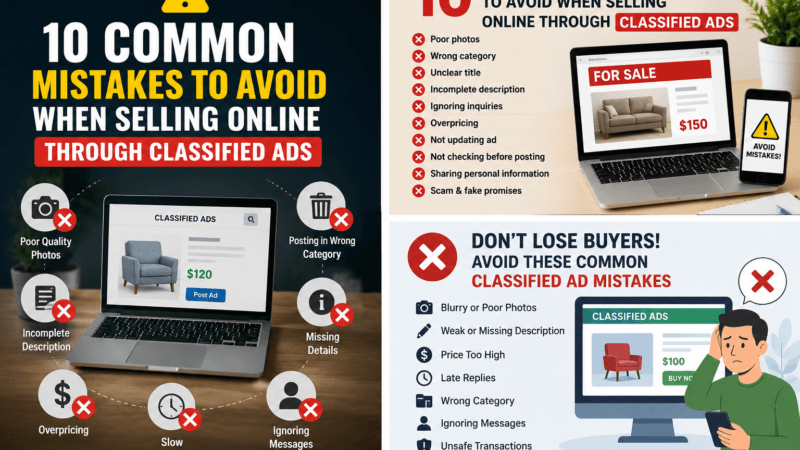
10 Common Mistakes to Avoid When Selling Online Through Classified Ads-adshad.com
Tips

10 Common Mistakes to Avoid,Selling Online Through Classified Ads

10 Common Mistakes to Avoid When Selling Online Through Classified Ads Selling online through classified ads is one of the fastest and most affordable ways for individuals and small businesses to reach buyers without paying expensive marketplace fees or running complex ad campaigns. Whether you’re clearing out household items, flipping products for profit, or running a full-fledged small business through platforms like Craigslist, Facebook Marketplace, or OLX, classified ads can generate real sales quickly — but only if you avoid the common pitfalls that cause listings to get ignored, flagged, or scammed. In this guide, we’ll walk through 10 Common Mistakes to Avoid When Selling Online Through Classified Ads, so you can create listings that attract serious buyers, close sales faster, and protect yourself from wasted time and fraud. If you’re also investing in paid promotion alongside your classified listings, pairing these tips with our guide on getting more bang for your buck with online ads can help you stretch your marketing budget even further. 1. Writing Vague or Incomplete Titles Your ad title is the single most important piece of real estate in your listing. Buyers scrolling through hundreds of classified ads make split-second decisions based on the title alone, and a vague title like “For Sale” or “Great Deal!” gives them no reason to click. Instead, include the specific item name, brand, model, size, or condition directly in the title — for example, “iPhone 13 Pro Max 256GB – Excellent Condition, Unlocked” performs far better than “Phone for Sale.” This is one of the most common mistakes to avoid when selling online through classified ads because a weak title kills your visibility before a buyer even opens the listing. Search algorithms on most classified platforms also weigh titles heavily, so specific, keyword-rich titles help your ad surface in more searches. 2. Using Poor-Quality or Stock Photos Buyers can’t physically inspect an item before purchasing it online, which means your photos carry the entire burden of building trust. Blurry images, poor lighting, or worse, using stock photos instead of real pictures of your actual item, are major red flags that cause buyers to scroll right past your listing or suspect a scam. Take multiple photos from different angles, in good natural lighting, showing any wear, damage, or unique features honestly. Listings with five or more clear photos consistently outperform listings with just one or two. If you’re selling a used item, include close-up shots of any flaws — this builds credibility and reduces the number of buyers who back out after seeing the item in person. 3. Overpricing or Underpricing Your Item Pricing is where many sellers stumble the most. Overpricing scares away potential buyers who assume you’re not serious about selling, while underpricing can make buyers suspicious that something is wrong with the item — or worse, it leaves money on the table that you didn’t need to give up. Before listing, spend 15–20 minutes researching what similar items are currently selling for on the same platform. This is the another most common mistakes to avoid when selling online through classified ads. Check completed or sold listings when possible, since active listings often reflect asking prices rather than actual sale prices. Pricing your item slightly above your minimum acceptable price also gives you room to negotiate, which many classified ad buyers expect. 4. Ignoring the Power of a Detailed Description A title gets the click, but the description closes the sale. Too many sellers write one-line descriptions like “Barely used, works great” without specifying key details buyers actually want to know — dimensions, age, reason for selling, included accessories, or known issues. A strong description should answer the questions a buyer would ask if they were standing in front of the item. This reduces the back-and-forth messaging that often causes buyers to lose interest, and it filters out unserious inquiries so you spend time only with buyers who are genuinely ready to purchase. 5. Failing to Respond Quickly to Inquiries This is the major common mistakes to avoid when selling online through classified ads. Classified ad buyers are often browsing multiple listings simultaneously, which means the seller who responds fastest usually wins the sale. Letting messages sit unanswered for a day or more is one of the most overlooked mistakes to avoid when selling online through classified ads, and it directly costs sales. Set up notifications for your listing platform and aim to respond within an hour or two whenever possible. Even a quick “Yes, still available!” keeps the buyer engaged and prevents them from moving on to a competing listing. 6. Not Verifying Buyers Before Meeting Safety should never be an afterthought when selling in person. A common and costly mistake is agreeing to meet a buyer without any basic verification or safety precautions. Scammers often target classified ad sellers with fake payment confirmations, counterfeit cash, or last-minute location changes designed to isolate the seller. Always meet in a public, well-lit location — many local police stations now offer designated “safe exchange zones” specifically for classified ad transactions. Trust your instincts if a buyer’s behavior feels off, and never accept a check, money order, or wire transfer for more than the agreed price, as this is one of the most common classified ad scams. 7. Posting in the Wrong Category Every classified ad platform organizes listings into categories, and posting in the wrong one — even accidentally — dramatically reduces your visibility to interested buyers. A power tool listed under “Home Goods” instead of “Tools & Equipment” simply won’t reach the buyers actively searching for it. Take the extra minute to choose the most specific and accurate category and subcategory available. On some platforms, miscategorized listings can even be flagged or removed, wasting the time you spent creating the ad in the first place. 8. Neglecting to Update or Renew Listings Classified ad platforms typically rank newer listings higher in search results, which means an ad that’s been sitting untouched for weeks will naturally lose visibility

Read More
Local & International Jobs-Stop Wasting Time: Best Job Search Websites in 2026adshad
Education Tips

Stop Wasting Time: Best Job Search Websites in 2026

The job market in 2026 has transformed dramatically. Gone are the days when scanning newspaper classifieds or checking a single job board would land you your dream position. Today’s job seekers face a paradox: more opportunities than ever before, but also more noise, competition, and complexity in finding the right fit so Stop Wasting Time and find Best Job Search Websites in 2026. If you’re spending hours scrolling through countless job listings only to submit applications into what feels like a black hole, you’re not alone. The average job seeker spends approximately 11 hours per week searching for jobs, yet only a fraction of those applications result in interviews. There’s a specific kind of exhaustion that comes from job hunting in 2026. You open five different tabs, apply to the same role twice because two sites scraped it from the same source, get an auto-rejection nine minutes later, and somehow still feel like you haven’t actually looked anywhere useful. Multiply that by weeks, and it’s no surprise so many job seekers say the search itself has become a part-time job. Part of the problem is that not all job sites are built for the same purpose, and using the wrong one for what you actually need is how people burn hours without results. <cite index=”9-1″>Some platforms are built for broad volume, some are better for networking, and some work best for flexible or freelance opportunities</cite>. So instead of listing every job board that exists, this is a practical breakdown of where to actually spend your time in 2026 — including a local option a lot of job seekers overlook entirely. If you’re new here, this post pairs well with two things we’ve covered before: our breakdown on why classified ads are still the best way to sell online in 2026, since the same “cut out the middleman” logic applies to job boards too, and our guide on 10 essential tips before renting a house, if you’re job hunting because you’re also relocating. The good news? The right job search platforms can dramatically cut down that time while improving your results. In 2026, AI-powered tools, specialized job boards, and smart networking platforms have revolutionized how we find work. This guide will walk you through the best job search websites available today and help you build a winning strategy. Understanding the Modern Job Search Landscape Before diving into specific platforms, it’s crucial to understand how the job search ecosystem has evolved. The modern job search isn’t just about finding listings anymore; it’s about leveraging technology, networking strategically, and presenting yourself in ways that beat automated systems. Three key shifts have reshaped job searching in 2026: Common Job Search Mistakes to Avoid Mistake 1: Waiting for the Perfect Job Perfect jobs are rare. Apply to positions where you meet 60-70% of requirements. Many job descriptions represent wish lists rather than strict requirements. Mistake 2: Ignoring Company Culture A great salary at a toxic company leads to misery. Always research: Mistake 3: Generic Applications Hiring managers can spot generic resumes instantly. Personalization matters: Mistake 4: Neglecting Your Online Presence Employers Google candidates. Ensure: Mistake 5: Not Following Up Following up shows interest and persistence: The Best Job Search Websites in 2026 1. LinkedIn Best For: Professional networking, industry research, and relationship-driven job searching LinkedIn remains the undisputed leader in professional networking with over 900 million users worldwide. What sets it apart in 2026 isn’t just its job board; it’s the integration of networking, personal branding, and job discovery. Key Features: Pro Tip: A well-optimized LinkedIn profile can attract opportunities without active applying. Recruiters search the platform constantly, making visibility critical. Update your headline, skills section, and ensure you’re using industry-relevant keywords. Pricing: Free basic account; Premium Career starts at $39.99/month 2. Indeed Best For: Broad job search across all industries and experience levels Since 2004, Indeed has built one of the most extensive job databases globally, with over 250 million users and millions of listings across every conceivable industry. Key Features: Why It Works: Indeed’s aggregation model pulls listings from company websites and other job boards, reducing the chance you’ll miss an opportunity. The platform’s simplicity makes it ideal for job seekers at any experience level. 3. ZipRecruiter Best For: AI-powered job matching and multi-platform reach ZipRecruiter has distinguished itself through smart matching technology that actively connects job seekers with relevant opportunities rather than making you search endlessly. Key Features: The Advantage: ZipRecruiter’s technology analyzes your profile and proactively suggests you to employers, inverting the traditional job search model. Instead of only searching for jobs, jobs find you. 4. Glassdoor Best For: Company research, salary transparency, and informed decision-making Glassdoor revolutionized job searching by prioritizing transparency. Beyond listings, it provides employee reviews, salary data, interview experiences, and company ratings. Key Features: Strategic Use: Never apply to a company without checking Glassdoor first. Understanding company culture, typical salary ranges, and interview processes gives you a significant advantage in preparation and negotiation. 5. FlexJobs Best For: Legitimate remote, hybrid, and flexible work opportunities FlexJobs has built its reputation on quality over quantity. Every listing is hand-screened to ensure legitimacy, making it invaluable for those seeking remote or flexible arrangements. Key Features: Why Pay?: While FlexJobs requires a subscription, the investment pays off by eliminating scam listings and time wasted on illegitimate opportunities. If flexibility is your priority, this platform delivers. 6. We Work Remotely Best For: Full-time remote positions across various industries Established in 2011, We Work Remotely has maintained its position as a leading remote job board through simplicity and quality. Key Features: The Appeal: Because companies pay to post on We Work Remotely, listings tend to be legitimate and from employers serious about hiring. The no-nonsense approach saves time. 7. Google for Jobs Best For: Comprehensive search aggregation and quick filtering Google for Jobs aggregates listings from across the web, displaying them directly in search results when you enter job-related queries. Key Features: How to Use: Simply search “jobs near me” or ”

Read More
Ideas Tips

10 Essential Tips You Must Know Before Renting a House

Searching for the perfect rental property? Understanding the 10 essential tips you must know before renting a house can save you thousands of dollars and countless headaches. Whether you’re transitioning from apartment living or renting for the first time, a house comes with unique considerations that require careful planning. This comprehensive guide covers everything from budgeting to legal protections, ensuring you make an informed decision that you won’t regret.

Read More
Three Powerful Tricks for Online Advertising
Tips

Three Powerful Tricks for Online Advertising: A Small Business Owner’s Guide to Getting More Bang For You Buck

In today’s competitive digital marketplace, small business owners are constantly searching for ways to maximize their advertising returns without draining their bank accounts. While large corporations can afford to throw money at every platform and test endlessly, small businesses need strategies that work immediately and efficiently. That’s exactly what you’ll discover in this guide. These three powerful tricks for online advertising have helped countless small businesses transform their marketing from a necessary expense into a profit-generating machine. Whether you’re advertising on Facebook, Google, Instagram, TikTok, or any other platform, these strategies will help you reach more customers, reduce your costs, and scale your business sustainably. If you’re a small business owner trying to make online advertising work without burning through your budget, you’re not alone. The digital advertising landscape can feel overwhelming, with platforms constantly changing their rules and big brands outspending you at every turn. But here’s the good news: smart strategy beats big budgets every single time. After working with countless small businesses, I’ve discovered that success in online advertising isn’t about how much you spend, it’s about how intelligently you spend it. In this article, I’ll share three powerful tricks that can dramatically improve your advertising results while actually reducing your costs. These aren’t theoretical concepts, they’re practical strategies you can implement starting today, whether you’re advertising on Facebook, Google, Instagram, or anywhere else online. Trick #1: Master the Art of Audience Layering (And Stop Wasting Money on the Wrong People) The single biggest mistake small business owners make with online advertising is treating their audience like one homogeneous group. They create one ad, target one broad audience, and wonder why their cost per conversion is sky-high. The truth is, not all potential customers are created equal, and your advertising strategy needs to reflect that reality. How Audience Layering Works Think of your potential customers as existing in different stages of awareness. Some people have never heard of your business. Others have visited your website but didn’t buy. Still others are past customers who might buy again. Each of these groups requires a completely different message and advertising approach, and most importantly, they have dramatically different costs associated with reaching them. Here’s where the cost-saving magic happens: advertising to people who already know your business is exponentially cheaper than advertising to cold audiences. A remarketing ad to someone who visited your website might cost you $2 per click, while reaching a completely cold audience could cost $8 per click for the same result. That’s a 4x difference in efficiency. Implementing Your Layered Strategy Start by creating at least three distinct audience layers: Layer 1: Warm Remarketing Audiences – These are people who’ve already interacted with your business. Set up pixel tracking on your website (it’s free on most platforms) and create campaigns specifically for website visitors, cart abandoners, and video viewers. Your message here should be direct and focused on overcoming objections or offering an incentive to complete their purchase. Allocate 40-50% of your budget here because these audiences convert at 3-5 times the rate of cold traffic while costing significantly less. Layer 2: Lookalike and Interest-Based Audiences – These are people who share characteristics with your best customers but haven’t discovered you yet. Most advertising platforms allow you to create “lookalike audiences” based on your customer list or website visitors. These audiences are warm-ish, they’re more receptive than completely cold traffic but still need education about your business. Allocate 30-40% of your budget here, using content that builds trust and demonstrates value before asking for the sale. Layer 3: Cold Prospecting Audiences – These are people who fit your demographic profile but have no relationship with your brand. This is where most small businesses waste their entire budget. Here’s the trick: don’t try to make the sale immediately. Instead, use this budget (20-30% maximum) to move people into Layer 2 by offering valuable content, free guides, or engaging videos. The goal is to get them to engage with your content so you can remarket to them later at a much lower cost. The Real-World Impact A local fitness studio I worked with was spending $3,000 monthly on Facebook ads targeting cold audiences with membership offers, generating only 8-10 new members. We restructured their approach using audience layering: $600 on cold traffic offering a free workout guide, $1,200 on remarketing to guide downloaders with testimonial videos, and $1,200 on remarketing to video viewers with membership offers. Within two months, they were generating 25-30 new members from the same $3,000 budget, a 3x improvement simply by matching the right message to the right audience temperature. Trick #2: Exploit the “Attention Arbitrage” Window (Before Everyone Else Catches On) Here’s a secret that big advertising agencies don’t want you to know: the most cost-effective advertising opportunities exist in the brief window when a platform or ad format is new, before it becomes saturated with advertisers. This concept, called attention arbitrage, has created millionaires out of early adopters who recognized the pattern. Understanding the Attention Arbitrage Cycle Every advertising platform goes through a predictable cycle. When a new platform or feature launches (think TikTok three years ago, or Instagram Reels more recently), they desperately need content creators and advertisers to make the platform valuable. To attract them, they essentially subsidize your advertising by giving you incredibly cheap reach. As more advertisers discover the opportunity, costs rise, and eventually, the platform becomes just as expensive as everywhere else. The trick is identifying and exploiting these windows before they close. Right now, in 2025, there are several underpriced attention opportunities that most small businesses are completely ignoring. Current Opportunities to Exploit YouTube Shorts Advertising – While most businesses have flocked to TikTok and Instagram Reels, YouTube Shorts advertising remains surprisingly underpriced. The platform is aggressively pushing Shorts to compete with TikTok, which means they’re giving advertisers favorable costs and reach. Small businesses advertising on YouTube Shorts are seeing cost-per-views 60-70% lower than Instagram Reels for similar audiences. Create short, authentic video content

Read More

Sign In

Register

Reset Password

Please enter your username or email address, you will receive a link to create a new password via email.