




































Free vs Paid Classified Ads-adshaad.com
Education Trends

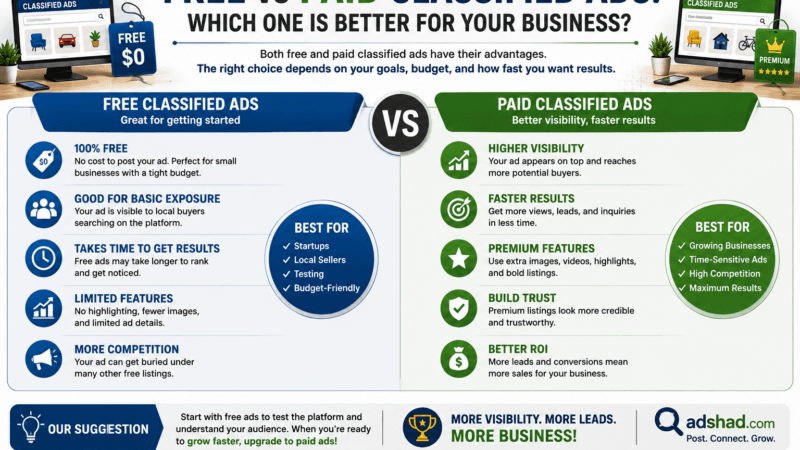
Free vs Paid Classified Ads: Which One Is Better for Your Business?

Free vs Paid Classified Ads: Which One Is Better for Your Business? If you’re trying to grow your business without draining your marketing budget, you’ve probably run into the same question every seller and small business owner eventually asks: free vs paid classified ads — which one actually delivers better results? Both options have loyal supporters, and both can genuinely grow your customer base, but they work in very different ways and serve different goals depending on your budget, timeline, and industry. In this guide, we’ll break down exactly how free and paid classified ads compare, the pros and cons of each, and how to decide which approach — or combination of both — makes the most sense for your business. If you’re new to classified advertising altogether, it’s worth starting with our beginner-friendly breakdown of free advertising for small business owners before diving into the paid side of the equation. What Are Free Classified Ads? Free classified ads are listings posted on platforms like Facebook Marketplace, Craigslist, Nextdoor, OLX, and Gumtree at no cost to the seller. These platforms allow individuals and businesses to post products, services, or job listings that are searchable by location, category, and keyword, giving sellers direct access to buyers actively looking for what they offer — without spending a single dollar on placement. Free classified ads have long been a go-to option for small businesses, side hustlers, and individual sellers who want visibility without committing to an advertising budget. They’re especially effective for local, high-intent searches, where buyers are already in “ready to purchase” mode. What Are Paid Classified Ads? Paid classified ads take the same basic concept — a listing describing your product or service — but add promotional features that increase visibility in exchange for a fee. This might include boosted placement at the top of search results, featured listing badges, extended listing duration, or inclusion in premium categories that free listings can’t access. Paid options are also common on platforms that combine classified-style listings with broader digital advertising, such as sponsored posts on Facebook Marketplace or premium listings on industry-specific classified sites like real estate or automotive platforms. Free vs Paid Classified Ads: Key Differences Understanding the core differences between free vs paid classified ads is the first step toward deciding which approach fits your business. 1. Cost and Budget Impact The most obvious difference is cost. Free classified ads require no monetary investment, only your time to write, post, and manage listings. Paid classified ads require an ongoing or one-time budget, which can range from a few dollars per listing to significantly more for premium placements or extended campaigns. For businesses with limited or inconsistent cash flow, free classified ads offer a way to generate leads without financial risk. Paid ads, on the other hand, require you to weigh the cost against expected return, which works best once you already understand your conversion rates and customer value. 2. Visibility and Reach Paid classified ads generally win when it comes to visibility. Boosted or featured listings appear higher in search results, sometimes with visual highlights like colored borders or “Featured” badges that make them stand out from free listings. This can be especially valuable in competitive categories where dozens of similar listings are competing for the same buyer’s attention. Free classified ads rely more heavily on strong titles, quality photos, and consistent reposting to maintain visibility, since they don’t benefit from algorithmic boosts or premium placement. 3. Speed of Results If you need leads quickly — for example, to fill a last-minute service slot or move inventory before a deadline — paid classified ads typically generate faster results due to their increased visibility. Free classified ads can still perform well, but results tend to build more gradually as your listings accumulate views and inquiries over time. 4. Longevity and Sustainability One advantage free classified ads hold is sustainability. Since there’s no ongoing cost, you can maintain a consistent presence on classified platforms indefinitely, refreshing and reposting listings as needed without worrying about a shrinking ad budget. Paid ads, by contrast, stop generating the same level of visibility the moment your budget runs out or your campaign ends. 5. Targeting Capabilities Paid classified ads often come with more advanced targeting options, especially on platforms integrated with broader ad networks like Facebook. This can include audience targeting by demographics, interests, or behavior, which free listings typically don’t offer. If precise targeting matters for your business — for example, reaching a very specific buyer persona — paid options may deliver a stronger return. When Free Classified Ads Make More Sense Free classified ads tend to be the better choice in several common scenarios: For businesses in this position, mastering free classified ads first often makes paid advertising more effective later, since you’ll already understand what messaging, pricing, and photos perform best. When Paid Classified Ads Make More Sense Paid classified ads tend to deliver a stronger return in different circumstances: Many successful sellers use paid classified ads strategically — not as a replacement for free listings, but as an accelerant once they’ve identified what’s already working organically. Combining Free and Paid Strategies: Free vs Paid Classified Ads Rather than viewing free vs paid classified ads as an either-or decision, the most effective long-term strategy often blends both. Start with free classified ads to test messaging, pricing, and category performance without financial risk. Once you identify listings that consistently generate strong engagement, consider boosting those specific listings with paid promotion to accelerate results and reach a wider audience. This hybrid approach lets you minimize wasted ad spend, since you’re only paying to amplify content you already know performs well, rather than guessing which offer will resonate with a paid audience from the start. If you’re building out your free classified strategy first, our detailed guide on 10 common mistakes to avoid when selling online through classified ads is worth reviewing, since many of the same principles — strong titles, honest photos, fast response times

Read More
How Small Businesses Can Get More Customers with Free Classified Ads-adshad.com
Education Trends

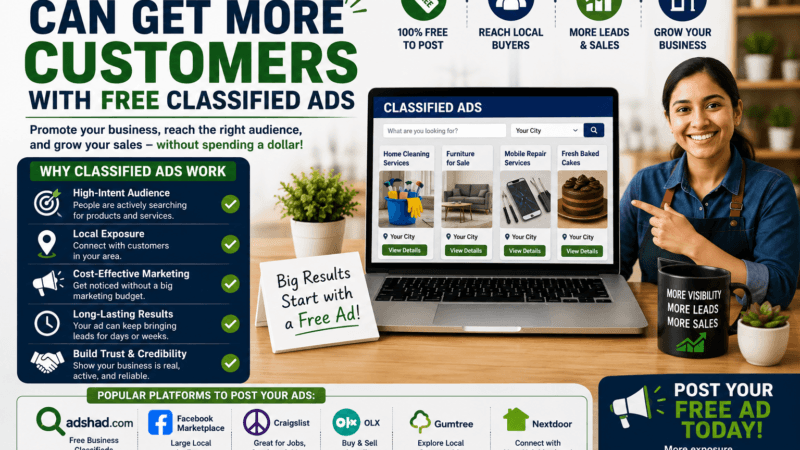
How Small Businesses Can Get More Customers with Free Classified Ads 2026

How Small Businesses Can Get More Customers with Free Classified Ads 2026 Marketing budgets are often the first thing small business owners cut when cash flow gets tight, but that doesn’t mean you have to stop attracting new customers. One of the most overlooked strategies for free advertising for small business owners is classified ads. Sites like Facebook Marketplace, Craigslist, OLX, Gumtree, and Nextdoor allow you to post listings for products, services, and promotions at zero cost, reaching thousands of local buyers who are already searching for exactly what you offer. In this guide, we’ll break down exactly how small businesses can use free classified ads to generate more leads, more foot traffic, and more sales — without spending a single dollar on ad placement. If you eventually want to scale beyond free listings, you can pair these strategies with paid tactics covered in our guide on three powerful tricks for online advertising, but for now, let’s focus on how to make the most of what’s already free. Why Free Classified Ads Still Work in 2026 It’s easy to assume that free advertising for small business owners is outdated in a world dominated by paid social media ads and search engine marketing, but classified ad platforms remain some of the highest-intent traffic sources available. Someone browsing “plumbers near me” or “used office furniture” on a classified site isn’t casually scrolling — they’re actively looking to buy or hire, which makes classified ads one of the most cost-efficient customer acquisition channels a small business can use. Unlike paid ads, which stop generating traffic the moment you stop paying, a well-optimized classified listing can continue attracting inquiries for days or weeks after posting, especially on platforms with strong local search visibility. For cash-strapped small businesses, this makes classified ads an ideal starting point before investing in paid campaigns. How Small Businesses Can Get More Customers with Free Classified Ads 2026 1. Choose the Right Platforms for Your Business Not all classified ad platforms serve the same audience, so the first step is identifying where your ideal customers actually spend time. Rather than spreading yourself thin across every platform, focus your energy on the two or three sites where your target audience is most active. This is a foundational part of any free advertising for small business strategy, since visibility means nothing if it’s reaching the wrong audience. 2. Write Titles That Stop the Scroll Just like paid ads, classified listings live or die by their titles. A vague title like “Cleaning Services Available” won’t compete with more specific listings like “Same-Day House Cleaning – Insured & Local – Free Quote.” Buyers browsing classified ads are scanning quickly, so your title needs to communicate the service, the benefit, and urgency or trust signals in just a few words. Include your city or neighborhood name in the title whenever possible, since many buyers filter classified searches by location. A title like “Affordable Lawn Care – Serving [Your City] Since 2015” immediately signals relevance and credibility to a local buyer scrolling through dozens of similar listings. 3. Use Clear, Professional Photos Even for service-based businesses, photos matter enormously in classified ads. A cleaning company can show before-and-after photos of a job, a contractor can showcase finished projects, and a retail seller should photograph products from multiple angles in good lighting. Listings without photos, or with blurry, low-effort images, are routinely skipped over by buyers who have no shortage of other options. If you’re a service business without an obvious “product” to photograph, consider including a photo of your team, your storefront, or your branded vehicle — this builds trust and helps your listing stand out from anonymous, text-only posts. 4. Write a Description That Sells Without Sounding Salesy Your classified ad description should answer the questions a potential customer would ask before contacting you: What exactly do you offer? What’s included? What’s your pricing range? Do you serve their area? Are you licensed, insured, or experienced? Avoid generic filler language and focus on specifics. Instead of “We offer great service at a great price,” write something like “Family-owned cleaning business serving [City] for 8 years. Flat-rate pricing, no hidden fees, and same-week availability.” Specificity builds trust faster than vague promises, and it reduces the number of unqualified inquiries you’ll need to filter through. 5. Include a Clear Call to Action Every classified ad should end with a direct, low-friction next step. “Message us for a free quote,” “Call or text to book your appointment,” or “Visit our page to see more photos” all give the buyer a clear path forward. Without a call to action, even a well-written listing can leave potential customers unsure of how to proceed, and many will simply move on rather than figure it out themselves. If your business has a website, Instagram page, or Google Business profile, include the link so interested buyers can quickly verify your legitimacy and browse more of your work before reaching out. 6. Post Consistently and Refresh Regularly Most classified platforms rank newer listings higher in search results, which means a single post from three weeks ago is likely buried under hundreds of newer listings by now. Free advertising for small business owners only works if you treat it as an ongoing habit rather than a one-time task. Set a recurring schedule — weekly or biweekly — to refresh, repost, or update your listings. Many platforms allow free renewals every few days, and taking advantage of this keeps your business visible to new buyers browsing the platform for the first time. 7. Leverage Multiple Categories and Listings If your business offers more than one product or service, don’t cram everything into a single listing. Create separate, specific listings for each core offering — a moving company, for example, might post separate ads for “local moving services,” “packing services,” and “furniture disposal,” each targeting a slightly different buyer intent. This approach increases your overall visibility across the platform’s search results and category browsing, giving you

Read More
10 Common Mistakes to Avoid When Selling Online Through Classified Ads-adshad.com
Tips

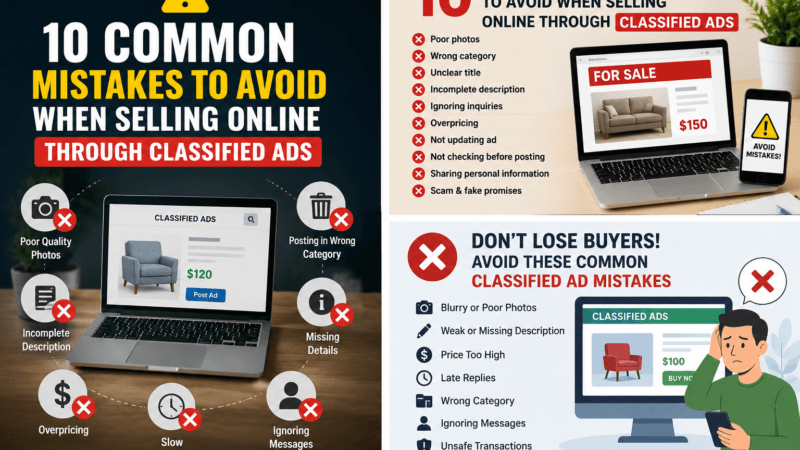
10 Common Mistakes to Avoid,Selling Online Through Classified Ads

10 Common Mistakes to Avoid When Selling Online Through Classified Ads Selling online through classified ads is one of the fastest and most affordable ways for individuals and small businesses to reach buyers without paying expensive marketplace fees or running complex ad campaigns. Whether you’re clearing out household items, flipping products for profit, or running a full-fledged small business through platforms like Craigslist, Facebook Marketplace, or OLX, classified ads can generate real sales quickly — but only if you avoid the common pitfalls that cause listings to get ignored, flagged, or scammed. In this guide, we’ll walk through 10 Common Mistakes to Avoid When Selling Online Through Classified Ads, so you can create listings that attract serious buyers, close sales faster, and protect yourself from wasted time and fraud. If you’re also investing in paid promotion alongside your classified listings, pairing these tips with our guide on getting more bang for your buck with online ads can help you stretch your marketing budget even further. 1. Writing Vague or Incomplete Titles Your ad title is the single most important piece of real estate in your listing. Buyers scrolling through hundreds of classified ads make split-second decisions based on the title alone, and a vague title like “For Sale” or “Great Deal!” gives them no reason to click. Instead, include the specific item name, brand, model, size, or condition directly in the title — for example, “iPhone 13 Pro Max 256GB – Excellent Condition, Unlocked” performs far better than “Phone for Sale.” This is one of the most common mistakes to avoid when selling online through classified ads because a weak title kills your visibility before a buyer even opens the listing. Search algorithms on most classified platforms also weigh titles heavily, so specific, keyword-rich titles help your ad surface in more searches. 2. Using Poor-Quality or Stock Photos Buyers can’t physically inspect an item before purchasing it online, which means your photos carry the entire burden of building trust. Blurry images, poor lighting, or worse, using stock photos instead of real pictures of your actual item, are major red flags that cause buyers to scroll right past your listing or suspect a scam. Take multiple photos from different angles, in good natural lighting, showing any wear, damage, or unique features honestly. Listings with five or more clear photos consistently outperform listings with just one or two. If you’re selling a used item, include close-up shots of any flaws — this builds credibility and reduces the number of buyers who back out after seeing the item in person. 3. Overpricing or Underpricing Your Item Pricing is where many sellers stumble the most. Overpricing scares away potential buyers who assume you’re not serious about selling, while underpricing can make buyers suspicious that something is wrong with the item — or worse, it leaves money on the table that you didn’t need to give up. Before listing, spend 15–20 minutes researching what similar items are currently selling for on the same platform. This is the another most common mistakes to avoid when selling online through classified ads. Check completed or sold listings when possible, since active listings often reflect asking prices rather than actual sale prices. Pricing your item slightly above your minimum acceptable price also gives you room to negotiate, which many classified ad buyers expect. 4. Ignoring the Power of a Detailed Description A title gets the click, but the description closes the sale. Too many sellers write one-line descriptions like “Barely used, works great” without specifying key details buyers actually want to know — dimensions, age, reason for selling, included accessories, or known issues. A strong description should answer the questions a buyer would ask if they were standing in front of the item. This reduces the back-and-forth messaging that often causes buyers to lose interest, and it filters out unserious inquiries so you spend time only with buyers who are genuinely ready to purchase. 5. Failing to Respond Quickly to Inquiries This is the major common mistakes to avoid when selling online through classified ads. Classified ad buyers are often browsing multiple listings simultaneously, which means the seller who responds fastest usually wins the sale. Letting messages sit unanswered for a day or more is one of the most overlooked mistakes to avoid when selling online through classified ads, and it directly costs sales. Set up notifications for your listing platform and aim to respond within an hour or two whenever possible. Even a quick “Yes, still available!” keeps the buyer engaged and prevents them from moving on to a competing listing. 6. Not Verifying Buyers Before Meeting Safety should never be an afterthought when selling in person. A common and costly mistake is agreeing to meet a buyer without any basic verification or safety precautions. Scammers often target classified ad sellers with fake payment confirmations, counterfeit cash, or last-minute location changes designed to isolate the seller. Always meet in a public, well-lit location — many local police stations now offer designated “safe exchange zones” specifically for classified ad transactions. Trust your instincts if a buyer’s behavior feels off, and never accept a check, money order, or wire transfer for more than the agreed price, as this is one of the most common classified ad scams. 7. Posting in the Wrong Category Every classified ad platform organizes listings into categories, and posting in the wrong one — even accidentally — dramatically reduces your visibility to interested buyers. A power tool listed under “Home Goods” instead of “Tools & Equipment” simply won’t reach the buyers actively searching for it. Take the extra minute to choose the most specific and accurate category and subcategory available. On some platforms, miscategorized listings can even be flagged or removed, wasting the time you spent creating the ad in the first place. 8. Neglecting to Update or Renew Listings Classified ad platforms typically rank newer listings higher in search results, which means an ad that’s been sitting untouched for weeks will naturally lose visibility

Read More
Local & International Jobs-Stop Wasting Time: Best Job Search Websites in 2026adshad
Education Tips

Stop Wasting Time: Best Job Search Websites in 2026

The job market in 2026 has transformed dramatically. Gone are the days when scanning newspaper classifieds or checking a single job board would land you your dream position. Today’s job seekers face a paradox: more opportunities than ever before, but also more noise, competition, and complexity in finding the right fit so Stop Wasting Time and find Best Job Search Websites in 2026. If you’re spending hours scrolling through countless job listings only to submit applications into what feels like a black hole, you’re not alone. The average job seeker spends approximately 11 hours per week searching for jobs, yet only a fraction of those applications result in interviews. There’s a specific kind of exhaustion that comes from job hunting in 2026. You open five different tabs, apply to the same role twice because two sites scraped it from the same source, get an auto-rejection nine minutes later, and somehow still feel like you haven’t actually looked anywhere useful. Multiply that by weeks, and it’s no surprise so many job seekers say the search itself has become a part-time job. Part of the problem is that not all job sites are built for the same purpose, and using the wrong one for what you actually need is how people burn hours without results. <cite index=”9-1″>Some platforms are built for broad volume, some are better for networking, and some work best for flexible or freelance opportunities</cite>. So instead of listing every job board that exists, this is a practical breakdown of where to actually spend your time in 2026 — including a local option a lot of job seekers overlook entirely. If you’re new here, this post pairs well with two things we’ve covered before: our breakdown on why classified ads are still the best way to sell online in 2026, since the same “cut out the middleman” logic applies to job boards too, and our guide on 10 essential tips before renting a house, if you’re job hunting because you’re also relocating. The good news? The right job search platforms can dramatically cut down that time while improving your results. In 2026, AI-powered tools, specialized job boards, and smart networking platforms have revolutionized how we find work. This guide will walk you through the best job search websites available today and help you build a winning strategy. Understanding the Modern Job Search Landscape Before diving into specific platforms, it’s crucial to understand how the job search ecosystem has evolved. The modern job search isn’t just about finding listings anymore; it’s about leveraging technology, networking strategically, and presenting yourself in ways that beat automated systems. Three key shifts have reshaped job searching in 2026: Common Job Search Mistakes to Avoid Mistake 1: Waiting for the Perfect Job Perfect jobs are rare. Apply to positions where you meet 60-70% of requirements. Many job descriptions represent wish lists rather than strict requirements. Mistake 2: Ignoring Company Culture A great salary at a toxic company leads to misery. Always research: Mistake 3: Generic Applications Hiring managers can spot generic resumes instantly. Personalization matters: Mistake 4: Neglecting Your Online Presence Employers Google candidates. Ensure: Mistake 5: Not Following Up Following up shows interest and persistence: The Best Job Search Websites in 2026 1. LinkedIn Best For: Professional networking, industry research, and relationship-driven job searching LinkedIn remains the undisputed leader in professional networking with over 900 million users worldwide. What sets it apart in 2026 isn’t just its job board; it’s the integration of networking, personal branding, and job discovery. Key Features: Pro Tip: A well-optimized LinkedIn profile can attract opportunities without active applying. Recruiters search the platform constantly, making visibility critical. Update your headline, skills section, and ensure you’re using industry-relevant keywords. Pricing: Free basic account; Premium Career starts at $39.99/month 2. Indeed Best For: Broad job search across all industries and experience levels Since 2004, Indeed has built one of the most extensive job databases globally, with over 250 million users and millions of listings across every conceivable industry. Key Features: Why It Works: Indeed’s aggregation model pulls listings from company websites and other job boards, reducing the chance you’ll miss an opportunity. The platform’s simplicity makes it ideal for job seekers at any experience level. 3. ZipRecruiter Best For: AI-powered job matching and multi-platform reach ZipRecruiter has distinguished itself through smart matching technology that actively connects job seekers with relevant opportunities rather than making you search endlessly. Key Features: The Advantage: ZipRecruiter’s technology analyzes your profile and proactively suggests you to employers, inverting the traditional job search model. Instead of only searching for jobs, jobs find you. 4. Glassdoor Best For: Company research, salary transparency, and informed decision-making Glassdoor revolutionized job searching by prioritizing transparency. Beyond listings, it provides employee reviews, salary data, interview experiences, and company ratings. Key Features: Strategic Use: Never apply to a company without checking Glassdoor first. Understanding company culture, typical salary ranges, and interview processes gives you a significant advantage in preparation and negotiation. 5. FlexJobs Best For: Legitimate remote, hybrid, and flexible work opportunities FlexJobs has built its reputation on quality over quantity. Every listing is hand-screened to ensure legitimacy, making it invaluable for those seeking remote or flexible arrangements. Key Features: Why Pay?: While FlexJobs requires a subscription, the investment pays off by eliminating scam listings and time wasted on illegitimate opportunities. If flexibility is your priority, this platform delivers. 6. We Work Remotely Best For: Full-time remote positions across various industries Established in 2011, We Work Remotely has maintained its position as a leading remote job board through simplicity and quality. Key Features: The Appeal: Because companies pay to post on We Work Remotely, listings tend to be legitimate and from employers serious about hiring. The no-nonsense approach saves time. 7. Google for Jobs Best For: Comprehensive search aggregation and quick filtering Google for Jobs aggregates listings from across the web, displaying them directly in search results when you enter job-related queries. Key Features: How to Use: Simply search “jobs near me” or ”

Read More
Hotel Adlon Kempinski -adshad-The World's Most Iconic 5-Star Luxury Hotels
Tourism

The World’s Most Iconic 5-Star Luxury Hotels: Where Elegance Meets Legendary Service

The World’s Most Iconic 5-Star Luxury Hotels There’s something magical about stepping into a hotel that doesn’t just offer accommodation, but an experience that lingers in your memory long after checkout. Around the world, a select collection of 5-star properties have transcended their role as mere places to stay, becoming cultural landmarks that define luxury hospitality. These aren’t just hotels—they’re destinations in their own right, each with a story to tell and a legacy that spans generations. Everyone knows the usual playbook for booking a hotel: open three or four booking sites, compare prices, maybe check a rewards program, book whichever one is cheapest after taxes and fees. It works, mostly. But there’s a second playbook that far fewer travelers use, and it can turn up deals the big booking engines never show you at all — classified websites. It sounds like an odd pairing at first. Classifieds bring to mind used furniture and secondhand cars, not hotel rooms. But once you understand what’s actually being listed on classified sites — direct owner rentals, extended-stay deals, last-minute room releases, small independent guesthouses that never bothered signing up with a major booking platform — it starts to make a lot more sense. This post breaks down how to actually use classified websites to find genuine hotel and lodging deals in 2026, where they beat the big booking engines, where they don’t, and how to avoid the scams that come with any platform involving upfront payment to a stranger. If you’re new to using classifieds for more than just secondhand goods, it’s worth reading our earlier piece on why classified ads are still the best way to sell online in 2026 first — the same core logic (direct connection, no middleman fees, local relevance) is exactly what makes them useful for travel deals too. How to Actually Search Classifieds for Hotel Deals 1. Search broad terms first. “Room for rent,” “guesthouse,” “monthly stay,” “extended stay lodging” — these often surface more listings than searching “hotel,” since a lot of independent lodging on classifieds isn’t labeled as a hotel at all. 2. Filter by location and dates aggressively. Classified sites don’t always have hotel-specific date filters, so be precise in your search terms and double-check every listing’s actual availability directly with the poster before assuming it’s current. 3. Cross-check the price against normal booking sites. Before committing, do a quick comparison against what a similar stay costs on a major platform. If a listing is priced dramatically below everything else nearby with no clear explanation, treat it as a flag to investigate further, not a reason to book immediately. 4. Ask for photos and verification. A legitimate host or small property owner will have no problem sending current photos, confirming the exact address, or hopping on a call to answer questions. Reluctance here is one of the clearest signs something isn’t right. 5. Read past reviews or references if any exist. Independent listings won’t always have the review infrastructure of a major platform, but a quick search of the property name or address can often turn up mentions elsewhere online. Common Scams to Watch For Because classified hotel and lodging listings don’t run through a centralized booking and payment system, they carry more of the responsibility for verification than a major OTA does. A few patterns worth knowing: If anything feels off, it’s always fine to walk away and book through a standard platform instead. No deal is worth the risk of losing a deposit to a scam listing. A Simple Comparison Major Booking Platforms Classified Websites Best for Standard 1–2 night hotel stays, branded hotels Extended stays, independent properties, local/last-minute lodging Pricing Commission built into rate, offset by loyalty programs Often lower, no platform commission Verification Built-in reviews, secure payment Manual — you verify the host yourself Flexibility Fixed rates, limited negotiation Direct negotiation often possible Inventory Massive, standardized Smaller, but includes properties big platforms miss Where to Start Looking If you want to try this approach on your next trip, Adshad’s Property category is a natural place to start — search by city, filter for short-term or extended stays, and reach out directly to listers instead of routing everything through a booking platform’s markup. It won’t replace a major OTA for a one-night stay at a national hotel chain, but for longer trips, local stays, or properties that never bothered listing anywhere else, it’s often where the actual deals are hiding. The Sail That Redefined Luxury Rising from the Persian Gulf like a billowing sail caught in the Arabian winds, the Burj Al Arab in Dubai has become synonymous with opulence on a scale the world had never seen. Often described as the world’s only 7-star hotel—though no official rating exists—this architectural marvel lives up to its extraordinary reputation. Each of its suites spans two floors, decorated with gold leaf and the finest materials money can buy. Your personal butler anticipates your every need, while a fleet of Rolls-Royces stands ready to whisk you wherever you desire. The Burj Al Arab didn’t just raise the bar for luxury hotels; it created an entirely new category. Parisian Elegance Perfected When Ernest Hemingway called the Ritz Paris home, he was joining a centuries-long tradition of the world’s most celebrated figures seeking refuge in this temple of French refinement. Since opening in 1898, the Ritz has been the beating heart of Parisian luxury, where Coco Chanel lived for decades and Princess Diana spent her final hours. Walking through its doors on Place Vendôme feels like stepping into a living museum of elegance, where every detail—from the impeccable Louis XVI décor to the legendary Bar Hemingway—speaks of a golden age that never quite ended. Similarly, Hotel de Crillon, one of Paris’s oldest luxury establishments, offers a different flavor of French grandeur. Overlooking the Place de la Concorde, this 18th-century palace has witnessed centuries of history while seamlessly blending heritage with contemporary sophistication. Its recent restoration brought modern luxuries while preserving the soul of old

Read More

Sign In

Register

Reset Password

Please enter your username or email address, you will receive a link to create a new password via email.